Vintage Folding Bike Restoration
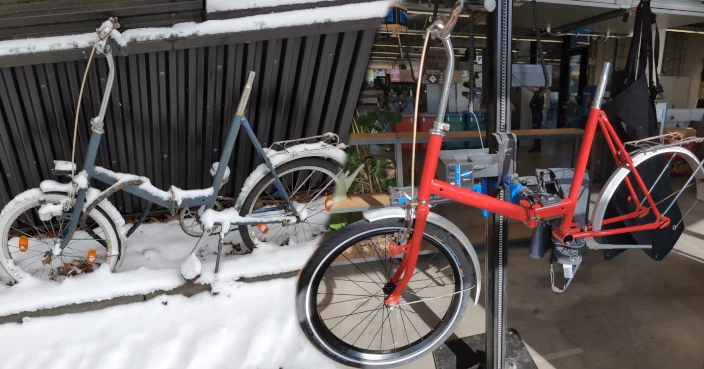
This is a journey into vintage bicycle restoration. I came here by accident, having worked only with modern bicycles before. The bike was standing outside in the snow for a while, next to the metal trash container of my local makerspace. Eventually I asked the shop foreman about it. Turns out he has restored quite a lot of these vintage folding bikes, but recently hasn’t found time to continue this project. So he gifted it to me…
A Rusty Mess
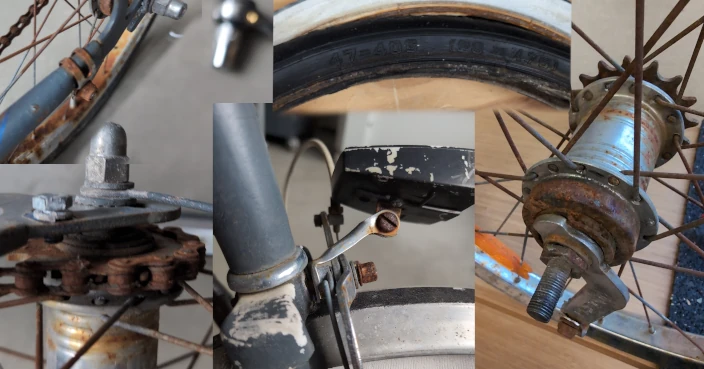
The amount of corrosion indicates the bike has been abandoned for some time. It is especially noticable on the steel rims and wheel hubs, with the parts covered in snow being affected most. Also, the bike has been overpainted (the plastic parts, too); Originally the frame was coloured cyan. Surely all of the parts could be replaced, maybe even upgraded. I found a used 20" kids bike on kleinanzeigen.de which had aluminium wheels with fresh tires. All for under 20€. Nevertheless, I decided against it and instead try to reuse as much as possible.
None of the parts are structurally damaged. They just need to be cleaned, freed from rust and repainted. Therefor the next step is a full disassembly. This is when I discovered the broken bottom bracket; water found its way inside the bearing and destroyed it beyond repair. The crank was completely stuck, too, which led me to forcefully removing it with the angle grinder. Maybe a bad decision. Finding a replacement part is not going to be easy…
Model and History
The rear wheel hub lever revealed the graving “PREDOM”. After online research, the name Romet poped up, which names a polish bicycle manufacturer. They have gone through serveral name changes: “PaFaRo”, “Zjednoczone Zakłady Rowerowe”, “Zakłady Rowerowe “Romet””, “Zakłady Rowerowe “Predom-Romet””, “Zakłady Rowerowe “Romet” S.A.”, “Arkus & Romet Group sp. z o.o.”, “Romet Sp. z o.o.”. My bicycle comes from the time where they carried the “Predom” prefix.
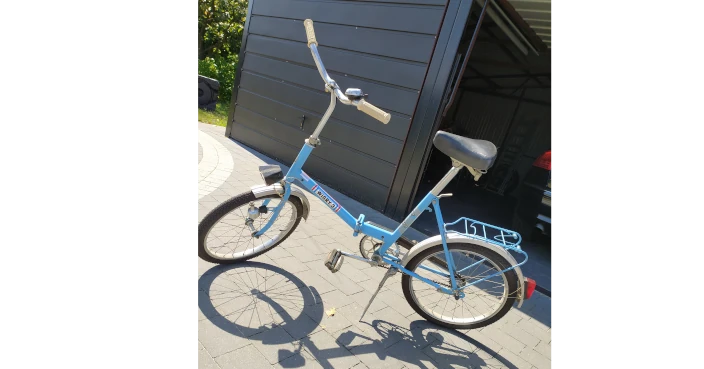

The bike is almost surely a Romet Wigry, more specifically a Wigry 3. And since it had a white plastic fork overlay it is likely to have been produced between 1976 and 1981; The cyan Wigry 3 from the example picture above has no such fork overlay, indicating a production date after 1985.
New Glance
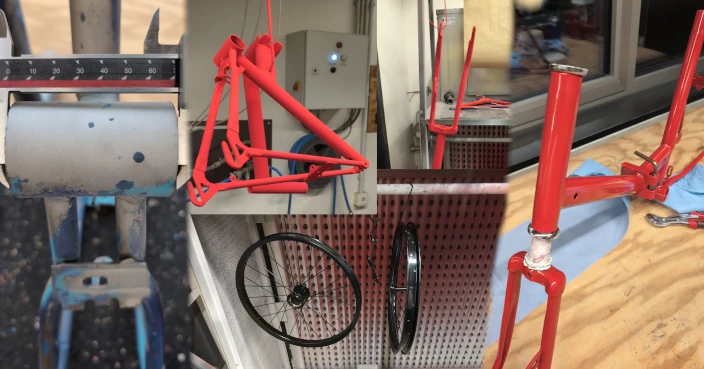
Having removed all bearings and peripherals, the frame is ready for sandblasting and powder coating. This is quite time consuming and took me multiple 2-hour sessions over the course of three weeks. Before the part goes into the oven its imporant to remove any grease from inside the tubing. Otherwise the fire alarm might kick off.
I decided to go with a red frame and black wheels. It gives the bike a fresh and modern look - doesn’t need to match the original colour. For the wheels I was lazy and kept the spokes on; It still worked. After baking for 20 mins at 220 degree celsius the wheels are still round and tensioned.
I really like the process of sandblasting and powder coating. It’s soo effective in giving old rusty parts a new life. And also really cheap, if you don’t take the working time into consideration. The powder was two buckets, one red, one black, for around 3€ each.
Bottom Bracket and Crank
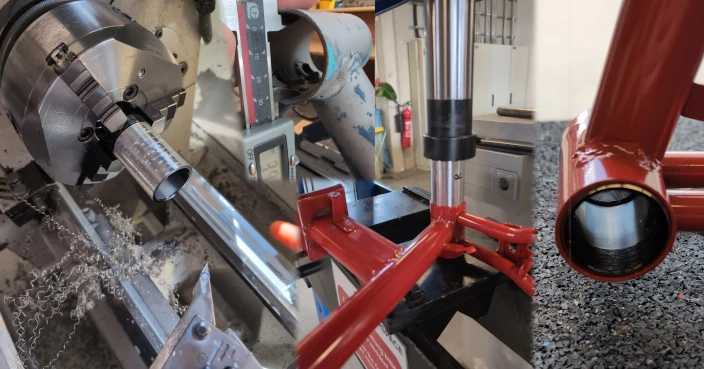
Well, Well, Well, If It Isn’t The Consequences Of My Own Actions. Now I need to fix the bottom bracket that I angle-grinded off before. Time for modernizing this section of the bike, making it servicable in the future. I found a used crank and standard bearing on kleinanzeigen.de. In order to fit it to the frame, I bought an adapter from BB30 to PSA (bottom bracket dimensions). Nevertheless, the adapter still had to be modified. There was no modern part which would fit my vintage wigry 3 directly. Hence I turned the adapter to the right outer diameter such that it could be press fitted into the frame’s steel tubing. This worked surprisingly well, and I am 100% sure it’s not going to move, ever.
Last Hurdles
When trying to replace the grease in the rear wheel hub, a broken bearing fell out. I wasn’t sure about the dimensions of the replacement part so I took it to a local bike shop, where I was greeted by a super friendly italian guy. He offered me an espresso and we had a chat, while he was working on a customer’s bike. Showed him a photo of my project, upon which he picked the right replacement bearing from his shelf and gifted it to me. What a nice guy.
Now the last puzzle pice to get the bike running is fitting the crank and aligning the front and rear sprockets. I didn’t have the right parts for that, which is why I used another sprocket as a spacer, shifting the front position about 8mm inwards. This was enough to let the chain run smoothly.
90% done is fine for now…
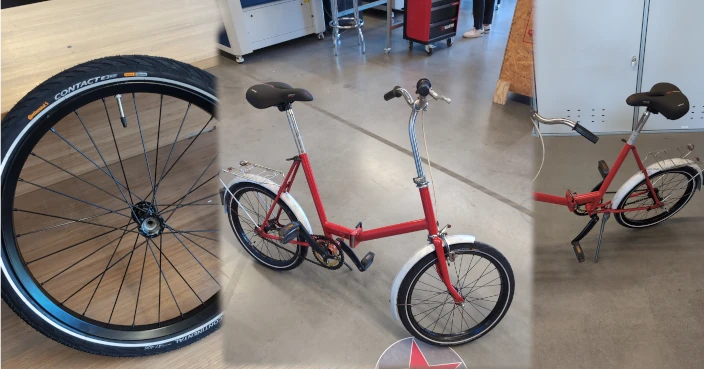
My background is informatics. In software development, going from a 90% solution to a 100% solution takes as long as going from 0% to 90% (The Ninety-Ninety Rule). I fear with this project it could be the same. Therefor the goal is to make it rideable first and eventually identify and fix the remaining pain-points gradually.
And I have a feeling that I’ll be using this bike quite a lot. Usually when carrying a bicycle on public transport you have to buy a seperate ticket. However, there’s an exception for foldable bikes. When folded, they are seen as baggage and can be taken without surcharge.